What is considered commercial cleaning: essential guide 2026
- support760146
- 10 hours ago
- 10 min read
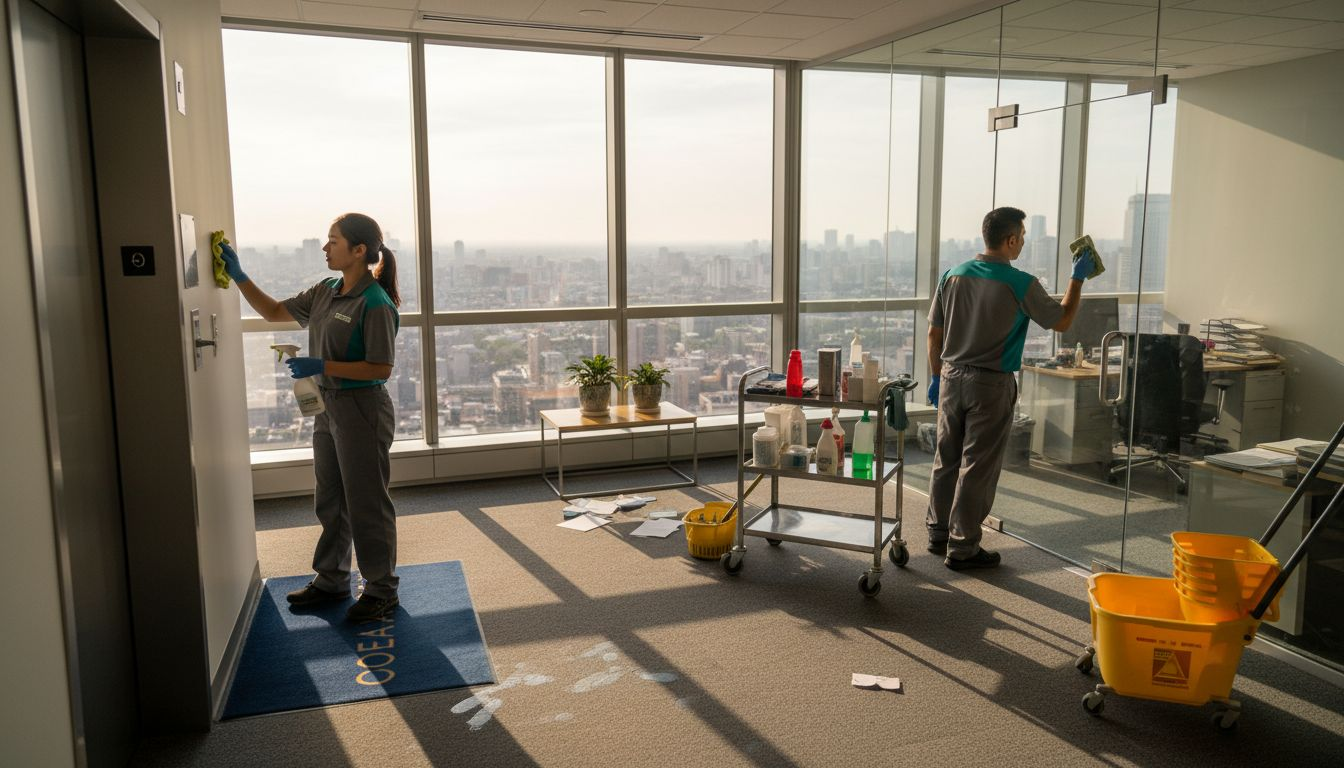
Many business owners and property managers confuse commercial cleaning with basic janitorial or residential services. Commercial cleaning is actually a highly specialized, technology-driven industry that targets non-residential properties with industrial-grade tools and trained professionals. This guide clarifies what commercial cleaning truly involves, from office spaces to vacation rentals and post-construction sites, and shows you how to choose quality services that protect your investment and maintain professional standards.
Table of Contents
Key takeaways
Point | Details |
Commercial cleaning targets non-residential properties using specialized equipment and trained staff, distinct from janitorial or residential services | Serves offices, retail spaces, vacation rentals, and post-construction sites with industrial-grade tools and regulatory compliance |
Modern commercial cleaning leverages technology including digital checklists, IoT sensors, and real-time monitoring for accountability | Day porter programs and targeted disinfection improve efficiency and enable measurable cleaning outcomes |
Specialized services address unique property needs: offices require workspace sanitation, vacation rentals demand rapid turnovers, post-construction sites need debris removal | Each property type requires tailored approaches, products, and expertise to meet specific cleaning challenges |
Eco-friendly cleaning practices meet growing client demand while improving indoor air quality and reducing environmental impact | 82% of commercial clients prefer green-certified cleaning services in 2026, reflecting industry sustainability trends |
Cost ranges from $0.05 to $0.30 per square foot with performance-based contracts offering quality assurance through inspections and digital documentation | Clear contract terms with measurable metrics reduce disputes and ensure consistent service delivery |
Definition and scope of commercial cleaning
Commercial cleaning targets non-residential properties including offices, retail stores, hospitality venues, and medical facilities. Unlike basic janitorial work, it requires industrial-grade equipment and trained professionals who understand specialized cleaning protocols and regulatory requirements. The U.S. commercial cleaning industry employs over 2 million workers, reflecting its massive scale and economic importance.
This field covers routine maintenance to specialized deep cleaning tasks. Standard services include floor care, restroom sanitation, trash removal, and surface disinfection. Specialized services address unique challenges like biohazard cleanup, post-construction debris removal, and vacation rental turnovers. Each facility type demands specific cleaning approaches, products, and scheduling to maintain professional standards.
Commercial cleaners work across diverse environments:
Office buildings requiring daily workspace maintenance and high-touch surface disinfection
Retail spaces needing customer-facing area upkeep and display cleaning
Hospitality properties demanding guest-ready sanitation and rapid turnovers
Medical facilities requiring strict infection control and compliance protocols
Educational institutions needing thorough classroom and common area cleaning
These professionals use specialized tools including commercial floor buffers, industrial vacuums, pressure washers, and hospital-grade disinfectants. Training covers proper chemical handling, equipment operation, safety protocols, and industry-specific regulations. Understanding why choosing commercial cleaning matters helps property managers recognize the value of professional expertise over basic cleaning approaches.
Commercial cleaning vs. janitorial and residential cleaning
Janitorial services focus on basic daily tasks like trash removal, sweeping, dusting, and light surface wiping. Janitors typically work in a single building and handle routine maintenance without specialized equipment or deep cleaning protocols. Their scope is limited to maintaining acceptable cleanliness levels rather than achieving thorough sanitization or addressing complex cleaning challenges.
Residential cleaning serves private homes with smaller-scale equipment and less stringent requirements. Home cleaners use consumer-grade products, work in familiar living spaces, and adapt to personal preferences rather than regulatory standards. The work involves dusting furniture, vacuuming carpets, cleaning kitchens and bathrooms, and general tidying without industrial processes.
Commercial cleaning involves scheduled, specialized tasks with measurable performance metrics. It operates under service contracts with specific deliverables, uses EPA-registered disinfectants, and follows industry standards like OSHA safety protocols and CDC guidelines. Commercial cleaners bring professional-grade extractors, power scrubbers, and specialized chemicals designed for tough commercial environments.
Feature | Janitorial | Residential | Commercial |
Scope | Basic daily tasks | Home cleaning | Specialized facility care |
Equipment | Light tools | Consumer products | Industrial-grade systems |
Standards | General cleanliness | Personal preference | Regulatory compliance |
Training | Minimal | Basic skills | Certified professionals |
Scheduling | Daily routine | Weekly/biweekly | Contract-based protocols |
Commercial cleaning includes specialized tasks impossible for janitorial or residential cleaners:
Post-construction debris removal and deep sanitization of new builds
Vacation rental turnovers with guest-ready standards and rapid scheduling
Medical-grade disinfection meeting healthcare facility requirements
Floor restoration including stripping, waxing, and high-speed buffing
These distinctions matter when selecting services. Understanding commercial cleaning services helps property managers match their facility needs with appropriate professional expertise and equipment capabilities.
Modern commercial cleaning practices and technology
Commercial cleaning has shifted from broad-spectrum approaches to targeted disinfection focusing on high-touch areas like door handles, light switches, elevator buttons, and shared equipment. This evidence-based method concentrates resources where contamination risk is highest, improving effectiveness while reducing chemical use and labor costs. Digital systems track which surfaces receive attention and when, creating accountability absent in traditional cleaning models.
Digital checklists, IoT sensors, and real-time monitoring revolutionize how cleaning teams document their work. Cleaners scan QR codes at each location, photograph completed tasks, and log supply usage through mobile apps. Building managers receive instant notifications of completed work with time-stamped verification. IoT sensors in restrooms and common areas detect foot traffic and usage patterns, triggering cleaning alerts when thresholds are met rather than following arbitrary schedules.
Day porter programs complement nightly deep cleans by providing continuous upkeep during business hours. Porters address immediate needs like spill cleanup, restroom checks, and trash removal while occupants are present. This hybrid approach maintains consistent cleanliness throughout the day instead of facilities deteriorating between evening cleaning sessions. Occupants see visible cleaning activity, building confidence in facility management.
Technology enables measurable cleaning outcomes through:
ATP testing devices measuring biological contamination levels on surfaces
UV light verification showing disinfectant coverage completeness
Digital inspection tools scoring cleaning quality against defined standards
Performance dashboards tracking completion rates, supply usage, and quality scores
Pro Tip: Request photo documentation and digital logs from your commercial cleaning provider. These records provide proof of service completion and help identify patterns if quality issues arise, protecting both parties in contract disputes.
Modern systems create transparency previously impossible in commercial cleaning. Property managers access detailed reports showing exactly what was cleaned, when, and by whom. This data-driven approach transforms cleaning from an invisible service to a measurable facility management function. Implementing a commercial cleaning checklist ensures all critical tasks receive consistent attention with documented verification.
Specialized commercial cleaning services: office, vacation rental, and post-construction
Office cleaning targets workspaces, conference rooms, restrooms, and common high-traffic areas where employees and visitors interact daily. Cleaners focus on desk surfaces, keyboards, phones, and shared equipment that harbor bacteria and viruses. Floor care includes vacuuming carpets, mopping hard surfaces, and maintaining entryways to prevent dirt tracking. Restroom sanitization follows strict protocols for toilets, sinks, mirrors, and dispensers. Break rooms require appliance cleaning, counter sanitization, and waste removal.
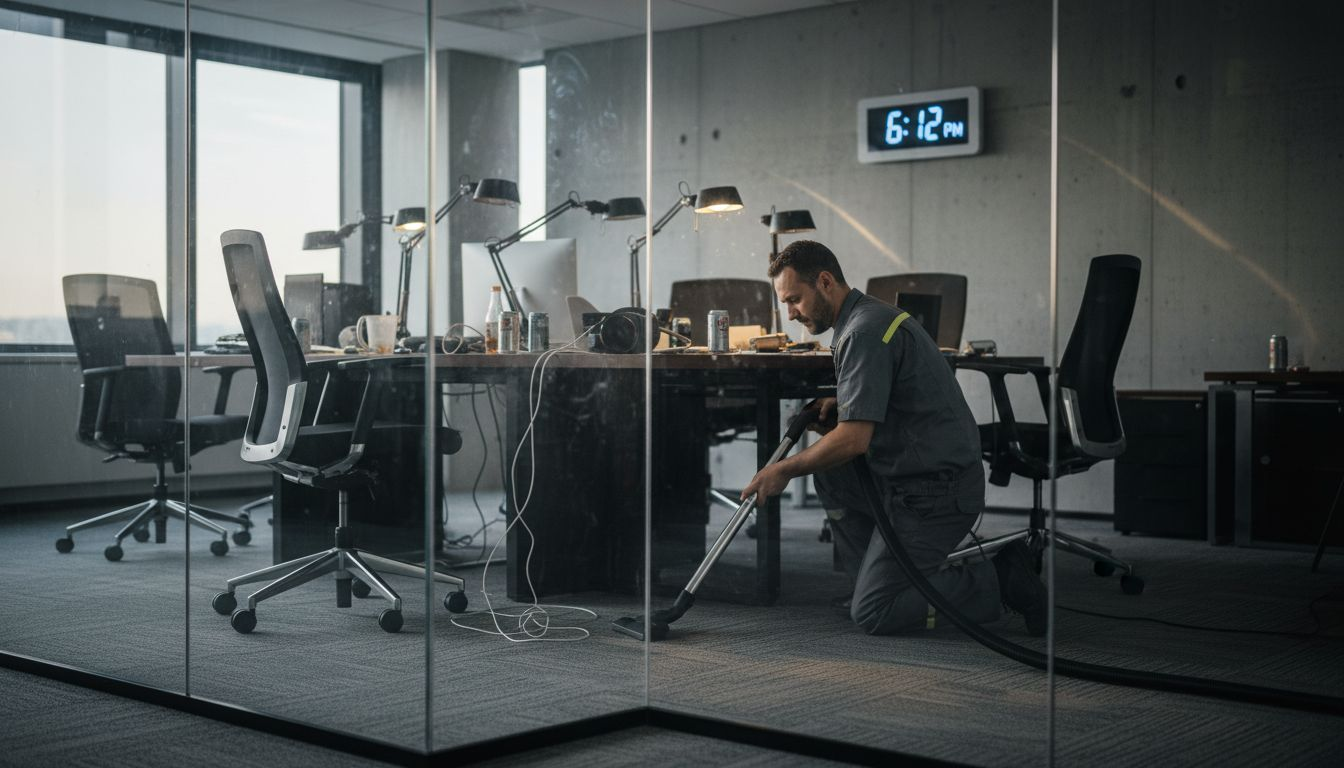
Vacation rental cleaning focuses on guest-ready presentation and rapid turnovers between bookings. Cleaners strip and remake beds with fresh linens, sanitize bathrooms to hotel standards, and thoroughly clean kitchens including appliances, dishes, and counters. They inspect for damage, restock supplies, and ensure amenities are guest-ready. Time pressure is intense since cleaning windows between checkout and check-in are often just hours. Quality must be consistently high because reviews directly impact booking rates and revenue.
Post-construction cleaning involves debris removal, dust elimination, and deep sanitization of newly built or renovated spaces. Initial rough cleaning removes construction materials, packaging, and large debris. Detail cleaning addresses fine dust on every surface including windows, fixtures, vents, and baseboards. Final cleaning prepares spaces for occupancy with floor polishing, fixture buffing, and thorough sanitization. This work requires specialized knowledge of construction residue removal without damaging new finishes.
Each property type demands specialized approaches:
Offices need scheduled cleaning minimizing disruption to business operations
Vacation rentals require flexible scheduling matching booking calendars
Post-construction sites need phased cleaning coordinating with construction timelines
Offices use moderate-strength cleaners safe for daily employee exposure
Vacation rentals need odor elimination and deep sanitization for guest confidence
Post-construction sites require heavy-duty products removing adhesives and coatings
Professional commercial cleaning services bring expertise matching each property type. Professional post-construction cleaning requires different skills and equipment than standard office maintenance. Understanding why professional cleaners benefit rentals helps property managers recognize specialized training value and avoid quality issues from using general cleaners for specialized needs.
Sustainability and eco-friendly commercial cleaning
Commercial clients increasingly demand green-certified cleaning products and methods that reduce environmental impact while maintaining effectiveness. Property managers recognize that sustainability aligns with corporate responsibility goals and tenant expectations. 82% of commercial clients prefer eco-friendly cleaning services as of 2026, making green practices a competitive advantage rather than a niche offering.
Eco-friendly cleaning improves indoor air quality by eliminating volatile organic compounds found in traditional chemical cleaners. Conventional products release fumes causing headaches, respiratory irritation, and allergic reactions. Green alternatives use plant-based ingredients, biodegradable formulas, and non-toxic disinfectants achieving comparable sanitization without harmful emissions. Improved air quality reduces employee sick days and enhances comfort for building occupants.
Sustainability practices extend beyond product selection to waste reduction and resource conservation. Microfiber cloths replace disposable paper products, reducing landfill waste. Concentrated cleaning solutions minimize plastic packaging and shipping emissions. Low-flow equipment conserves water without sacrificing cleaning power. These practices meet client expectations while reducing operating costs through efficient resource use.
Choosing eco-friendly services enhances tenant satisfaction and regulatory compliance. Many municipalities and industry certifications now require or incentivize green cleaning practices. LEED certification for buildings includes cleaning protocols in sustainability scoring. Tenants, especially younger professionals, prefer workspaces demonstrating environmental responsibility. Property managers using green cleaning approaches gain marketing advantages and meet evolving regulatory requirements.
Green cleaning represents practical business strategy rather than idealistic preference. Products have matured to match traditional cleaner effectiveness while eliminating health and environmental concerns. Cost premiums have narrowed as demand increased and production scaled. Commercial cleaning providers offering certified green services position themselves for long-term market growth as sustainability requirements tighten across industries.
Common misconceptions about commercial cleaning
Many believe commercial cleaning is simply janitorial work at a larger scale. In reality, commercial cleaning requires specialized training, industrial equipment, and regulatory compliance absent from basic janitorial services. Cleaners must understand chemical safety, infection control protocols, and facility-specific requirements. They operate professional-grade extractors, floor machines, and disinfection systems requiring certification and experience.
Some assume residential cleaners can handle commercial properties without adjustment. Commercial environments face higher traffic, tougher soiling, and stricter standards than homes. Equipment scaled for residential use fails in commercial settings. Consumer products lack the strength and longevity needed for commercial applications. Professional commercial cleaners bring appropriate tools and expertise for non-residential challenges.
Another misconception is that all commercial cleaning is the same. Office cleaning differs dramatically from vacation rental turnovers or post-construction cleanup. Each property type demands unique protocols, products, and scheduling. Assuming one commercial cleaner can handle all property types leads to poor results and frustrated clients. Specialized providers focusing on specific property types deliver superior outcomes through targeted expertise.
Some dismiss sustainability focus as marketing hype without real industry commitment. Commercial cleaning companies have genuinely invested in green practices responding to client demand and regulatory pressure. Certified green products now match traditional cleaner effectiveness. Major industry players have reformulated product lines and retrained staff. This shift represents fundamental industry transformation rather than superficial greenwashing.
Key misconceptions to avoid:
Commercial cleaning requires only basic skills and consumer products
Any cleaner can transition between residential and commercial work seamlessly
Post-construction cleaning is just thorough dusting and sweeping
Green cleaning sacrifices effectiveness for environmental benefits
Quality is similar across all commercial cleaning providers
Pro Tip: Interview potential commercial cleaning providers about specific experience with your property type. Ask about training programs, equipment inventory, and relevant certifications. Providers specializing in your facility type deliver better results than generalists claiming universal expertise.
Cost and quality assurance in commercial cleaning
Commercial cleaning pricing ranges from $0.05 to $0.30 per square foot depending on service complexity, frequency, and facility type. Basic office cleaning at the lower end includes trash removal, vacuuming, and surface wiping. Comprehensive programs including floor care, restroom deep cleaning, and specialized sanitization command premium pricing. Frequency impacts cost, with nightly service costing more monthly than weekly schedules despite lower per-visit rates.
Service Type | Price Range per Sq Ft | Typical Frequency |
Basic office cleaning | $0.05 to $0.10 | 3-5 times weekly |
Deep office cleaning | $0.15 to $0.20 | Weekly or biweekly |
Vacation rental turnover | $0.20 to $0.30 | Per booking |
Post-construction cleanup | $0.25 to $0.40 | One-time or phased |
Performance-based contracts offer measurable cleaning quality through defined standards and accountability mechanisms. These agreements specify completion criteria for each task, inspection protocols, and quality scoring systems. Cleaning must meet documented standards or providers face penalties or contract termination. This approach protects clients from substandard work while giving providers clear expectations.
Quality assurance methods ensuring consistent service:
Regular inspections by facility managers using standardized checklists
Digital photo documentation of completed work with time stamps
ATP testing measuring biological contamination on surfaces
Occupant satisfaction surveys gathering feedback on cleaning quality
Third-party audits verifying compliance with contract specifications
Clear contract terms reduce disputes and improve satisfaction. Specifications should detail exact tasks, products used, completion timelines, and quality standards. Include provisions for communication protocols, issue resolution procedures, and performance reviews. Document expected response times for emergency cleanups and special requests. Transparency in pricing, including any additional fees for supplies or special services, prevents surprise charges.
Quality assurance protects your investment and maintains professional facility standards. Contracts lacking clear metrics and inspection procedures invite inconsistent service and finger-pointing when problems arise. Insist on documented quality control measures and regular performance reviews as standard contract elements rather than optional add-ons.
Experience expert commercial cleaning with My Lemon Maids
Property managers in St. Augustine, Ponte Vedra, and Nocatee trust My Lemon Maids for commercial cleaning that combines professional expertise with transparent accountability. Our services address offices, vacation rentals, and post-construction sites with industrial-grade equipment and eco-friendly products tailored to each property type.

We bring specialized experience to your commercial properties. Our commercial cleaning services include digital documentation, performance tracking, and quality assurance protocols ensuring consistent results. Whether you need office cleaning services maintaining productive workspaces or post-construction cleaning experts preparing new builds for occupancy, our trained professionals deliver measurable outcomes matching your facility standards and budget requirements.
Frequently asked questions about commercial cleaning
What is the difference between commercial cleaning and janitorial services?
Commercial cleaning includes scheduled, specialized tasks using industrial equipment and EPA-registered disinfectants with measurable performance outcomes. Janitorial services handle basic daily maintenance like trash removal and light surface cleaning without specialized training or deep sanitization protocols.
Why is specialized cleaning important for vacation rentals and post-construction sites?
Vacation rentals require rapid turnovers with guest-ready sanitization meeting hospitality standards, directly impacting reviews and bookings. Post-construction sites need systematic debris removal, fine dust elimination, and deep cleaning to ensure safety and prepare spaces for occupancy without damaging new finishes.
How do eco-friendly commercial cleaning practices benefit my property?
Eco-friendly practices improve indoor air quality by eliminating volatile organic compounds, reducing occupant health complaints and sick days. These methods reduce waste through reusable materials and concentrated products while meeting tenant sustainability expectations and regulatory requirements for green building certifications.
What should I look for in a commercial cleaning contract to ensure quality service?
Look for performance-based terms specifying measurable completion criteria, regular inspection protocols, and digital documentation requirements. Clear cleaning schedules, transparent pricing including supply costs, and defined quality scoring systems with consequences for substandard work protect your interests and ensure consistent service delivery.
Recommended