Smarter office cleaning tips: boost hygiene and efficiency
- Glenn Brosnick
- 3 days ago
- 9 min read
TL;DR:
A clean office protects employees’ health and maintains productivity by reducing indoor air pollution. Implementing zoned checklists, routine, and periodic deep cleaning strategies ensures comprehensive hygiene and air quality improvements. Professional cleaning services can help maintain effective workflows, detailed attention, and adherence to health standards consistently.
A clean office is not just about looking professional when clients walk in. It is about protecting the health of everyone who works there and keeping your team productive throughout the day. Studies show that indoor air can be 2 to 5 times more polluted than outdoor air, and most of that contamination comes from everyday office activities. If you manage a workspace in St. Augustine, Ponte Vedra, or Nocatee, this guide gives you practical, up-to-date strategies to clean smarter, not just harder.
Table of Contents
Key Takeaways
Point | Details |
Follow a zoned checklist | Break your office into zones using a checklist to ensure every area gets cleaned thoroughly and efficiently. |
Mix routine and deep cleaning | Pair daily routines with periodic deep-clean tasks to eliminate both surface dirt and hidden buildup. |
Choose IAQ-first products | Select certified cleaning products to improve indoor air quality and reduce the risk of illness. |
Target high-touch areas | Disinfect door handles, electronics, and other shared surfaces daily to cut down on germs. |
Staged execution matters | Scheduling after-hours or staged cleaning minimizes office disruption and gets real results. |
Start with a zoned checklist-driven approach
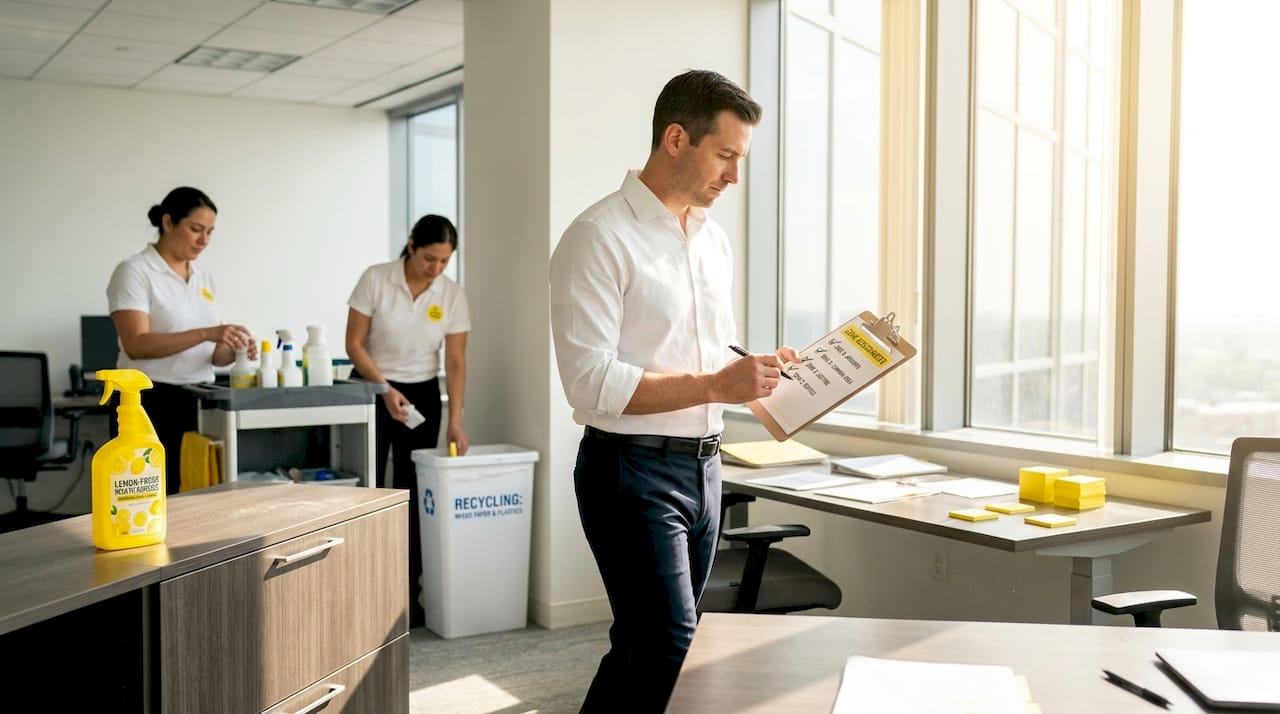
The biggest mistake most office managers make is cleaning reactively. Something looks dirty, so you clean it. That approach leaves gaps. A structured, zoned cleaning workflow divides your office into logical sections and assigns specific tasks to each one, so nothing gets skipped.
Here is how to set up your zones:
Reception and lobby: High-traffic entry points that create first impressions. Focus on floors, glass doors, seating surfaces, and front desk surfaces.
Workstation areas: Individual desks, monitors, keyboards, chairs, and shared storage units.
Kitchen and break room: Appliances, countertops, sinks, microwave interiors, and refrigerator shelves.
Restrooms: Toilets, sinks, mirrors, floors, and all touch points including faucet handles and paper towel dispensers.
Meeting rooms: Tables, chairs, shared screens, remote controls, and whiteboards.
Overlooked zones: Ceiling vents, baseboards, behind appliances, and window sills.
The CleanCorp 2025 checklist recommends dividing the office into zones, decluttering first, and explicitly including frequently missed areas like ceiling vents and high-touch surfaces such as door handles and light switches. That guidance is worth following closely.
Before any scrubbing or disinfecting begins, declutter. Remove paper piles, clear desk surfaces, and organize supply closets. Cleaning around clutter means you are not actually cleaning the surface underneath. Decluttering first makes every subsequent step faster and more thorough.
Pro Tip: Print your zone checklist and post it in a visible spot for your cleaning staff or service provider. A physical checklist reduces the chance of skipped tasks by giving everyone a clear, shared reference point.
Once you have your zones mapped out, review your office cleaning steps to make sure each zone has a defined sequence. For example, always clean from top to bottom within each zone so dust and debris fall to the floor before you mop or vacuum.
Blend routine with periodic deep cleaning
Not every cleaning task needs to happen every day. But some tasks that only happen occasionally can have a huge impact on hygiene and air quality if they are skipped too long. Understanding what office cleaning includes at each frequency level helps you build a sustainable schedule.
Here is a practical breakdown of task cadence:
Frequency | Tasks |
Daily | Empty trash bins, wipe high-touch surfaces, clean restrooms, vacuum entry areas |
Weekly | Mop hard floors, wipe down all desks and chairs, clean kitchen appliances, dust visible surfaces |
Monthly | Clean inside refrigerators, wipe light fixtures, sanitize upholstered furniture, clean window interiors |
Quarterly | Deep clean carpets, scrub grout in restrooms and kitchens, clean ceiling vents and air returns |
Annually | Clean behind large appliances, wash exterior windows, inspect and clean HVAC components |
Periodic cleaning is framed as the deep-dive maintenance that prevents the gradual buildup of grime, allergens, and bacteria that routine cleaning cannot address on its own. Think of it this way: daily cleaning keeps the office presentable, but periodic deep cleaning keeps it genuinely sanitary.
Here is how to integrate both approaches effectively:
Assign daily tasks to in-house staff or a daily cleaning crew. These are quick, repeatable tasks that take 30 to 60 minutes depending on office size.
Schedule weekly tasks for a set day each week. Friday afternoons work well for many offices because the workspace is less busy and the office starts the next week fresh.
Book monthly and quarterly tasks with a professional cleaning service. These tasks require more time, specialized equipment, and products that most in-house staff do not have access to.
Plan annual deep cleans around low-occupancy periods. Holiday shutdowns or slow business seasons are ideal times to tackle behind-appliance cleaning and HVAC work.
Pro Tip: Use a shared digital calendar to schedule all cleaning tasks by frequency. This keeps everyone accountable and makes it easy to see at a glance when a quarterly carpet clean or vent cleaning is due.
The types of cleaning jobs involved in a full office program are broader than most managers realize. Explore the types of cleaning jobs that apply to different property types to make sure your schedule covers every category relevant to your space.
Elevate air quality with smarter product and equipment choices
Here is something that surprises a lot of office managers: the cleaning products you use can actually make indoor air quality worse if you choose the wrong ones. Strong chemical cleaners release volatile organic compounds (VOCs), which are gases that irritate the respiratory system and contribute to poor air quality. This is especially relevant in Florida offices where windows are often kept closed for air conditioning.
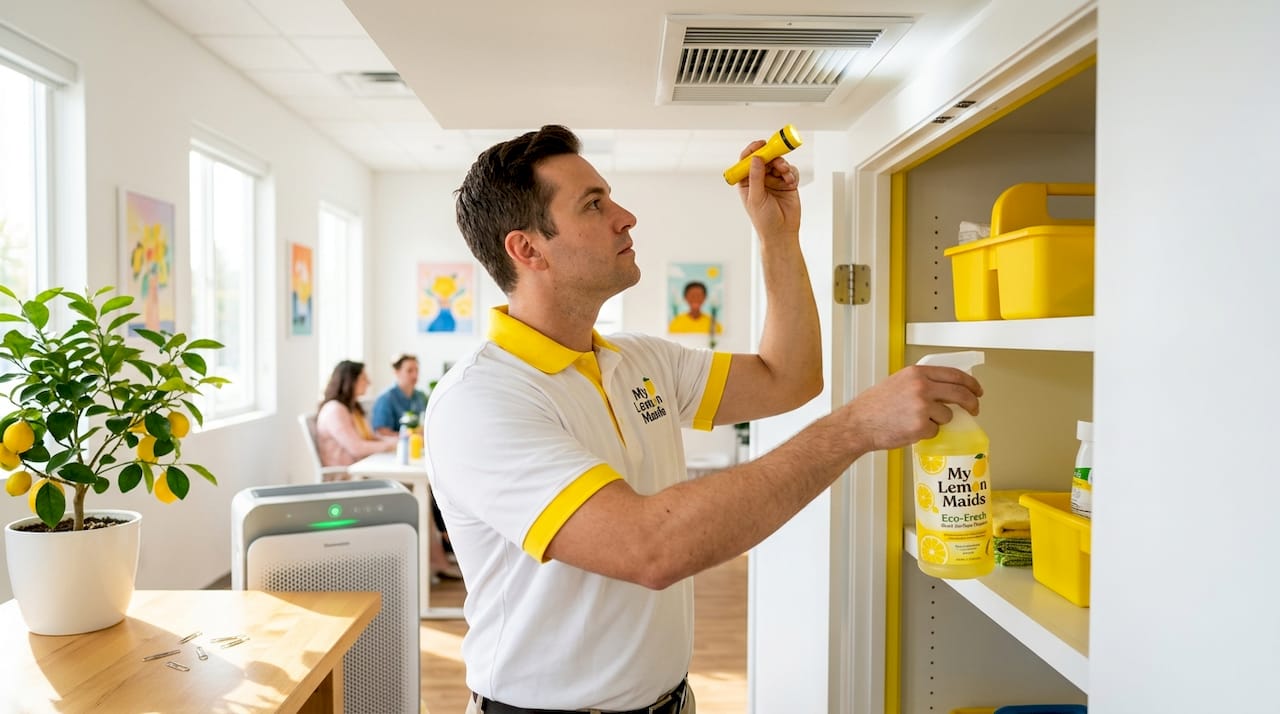
Indoor air can be 2 to 5 times more polluted than outdoor air, according to EPA and American Lung Association data. That makes your product choices a direct health decision.
Look for products with these certifications:
EPA Safer Choice: Indicates the product meets strict safety standards for human health and the environment.
Green Seal: An independent certification that covers performance, health, and environmental impact.
UL ECOLOGO: Verifies reduced environmental impact across the product’s full lifecycle.
Beyond product selection, your equipment choices matter just as much. Standard vacuum cleaners can recirculate fine dust and allergens back into the air. HEPA filter vacuums (High Efficiency Particulate Air) capture 99.97% of particles as small as 0.3 microns, including dust mites, mold spores, and pollen. For offices in coastal areas like St. Augustine and Ponte Vedra, where humidity can drive mold growth, HEPA filtration is especially important.
“Cleaning for health means selecting products and equipment that reduce airborne contaminants, not just move them from one surface to another. The goal is to remove pollutants from the building entirely.”
Additional air quality strategies for your office:
Open windows or increase ventilation during and immediately after cleaning to flush out any product residue.
Avoid aerosol sprays in enclosed spaces. Use pump sprays or pre-moistened wipes instead.
Allow cleaned surfaces to dry completely before staff return to the area.
Use microfiber cloths instead of cotton rags. Microfiber captures and holds particles rather than spreading them across surfaces.
For a full breakdown of how to apply these principles in a commercial setting, the commercial cleaning success guide covers product selection, equipment standards, and workflow sequencing in practical detail.
Target high-touch and easy-to-miss areas
You can mop every floor and wipe every desk in your office, and still have a hygiene problem. Why? Because the surfaces that transfer the most bacteria are often the ones that get the least attention. OfficeFinder’s 2025 spring-cleaning guide explicitly calls out disinfecting shared electronics and controlling cross-contamination as critical steps that most standard cleaning routines miss entirely.
Here is a comparison of commonly cleaned surfaces versus frequently overlooked ones:
Commonly cleaned | Frequently overlooked |
Desks and tables | Keyboard keys and mouse surfaces |
Restroom sinks | Faucet handles and soap dispensers |
Kitchen counters | Microwave door handles and buttons |
Floor surfaces | Baseboards and floor vents |
Trash bins (emptied) | Trash bin exterior and lid |
Conference room tables | Remote controls and light switches |
High-touch zones that need daily disinfection include:
Light switches in every room
Door handles and push plates on all entry and exit points
Elevator call buttons
Shared keyboards, mice, and touchscreens
Copier and printer control panels
Coffee machine buttons and handles
Refrigerator door handles
To prevent cross-contamination, meaning the transfer of bacteria from one surface to another during cleaning, follow a clean-to-dirty workflow:
Start with the cleanest areas first, such as private offices and conference rooms.
Move to shared workspaces and break rooms next.
Clean restrooms last, using a completely separate set of cloths and mop heads.
Use color-coded microfiber cloths for different zones. For example, blue for workstations, red for restrooms, and green for kitchens.
Never use the same cloth on a restroom surface and then on a kitchen surface, even if you think it looks clean.
A well-organized commercial cleaning checklist will include all of these high-touch points and assign them to the correct frequency and zone. If your current checklist does not include light switches and shared electronics, it is time to update it.
A realistic look at what actually transforms office cleaning routines
Most office managers focus heavily on what they can see. Dusty shelves get wiped. Stained carpet gets spot-cleaned. Dirty windows get noticed and reported. But the things that most affect employee health and productivity are invisible. Poor indoor air quality does not announce itself with a visible warning sign. It shows up as increased sick days, afternoon headaches, and staff who feel drained by mid-morning.
In our experience working with offices across St. Johns County, the biggest gap is not effort. Most office managers genuinely care about cleanliness. The gap is sequencing and consistency. A cleaning crew that works without a structured zone plan will inevitably spend too long on visible areas and rush through or skip the overlooked ones. The ceiling vents go uncleaned for months. The baseboards collect dust that circulates back into the air every time the HVAC kicks on.
The 2025 deep-clean guidance makes a strong case for checklist-plus-zonal sequencing as the method that reduces both missed areas and schedule overruns. We agree completely. A properly sequenced clean, done after hours when staff are not present, is more thorough and less disruptive than cleaning around people during the workday.
After-hours cleaning also allows for better ventilation. You can open windows, run fans, and let surfaces dry fully before anyone returns in the morning. That matters for air quality and for the effectiveness of disinfectants, which need dwell time (the time a product stays wet on a surface) to actually kill pathogens.
The honest truth is that a great office cleaning routine is not about doing more. It is about doing the right things in the right order, on the right schedule, with the right products. That is what separates a workspace that looks clean from one that actually is clean. Review your office cleaning workflow regularly and adjust it as your team size, office layout, or seasonal conditions change.
Professional support for your office cleaning game plan
The strategies in this guide are actionable and effective when applied consistently. But keeping up with zoned checklists, periodic deep cleans, and air quality standards takes time and expertise that most in-house teams are stretched to provide.
My Lemon Maids provides office cleaning services for businesses across St. Augustine, Ponte Vedra, and Nocatee, covering everything from daily maintenance to full detailed deep cleaning that targets the high-touch zones, ceiling vents, and overlooked areas that standard cleaning misses. Our teams follow structured checklists and zoned workflows on every visit. If you need broader commercial cleaning help for a larger facility or multi-space property, we offer flexible scheduling and specialized services to match your needs. Contact us today to get a quote and put a reliable cleaning plan in place for your workspace.
Frequently asked questions
How often should high-touch surfaces be disinfected in offices?
High-touch surfaces should be disinfected daily, with special attention during cold and flu season or outbreaks. OfficeFinder’s 2025 guide specifically identifies shared electronics and door handles as priority targets for daily disinfection.
What cleaning products are best for improving office air quality?
Use EPA Safer Choice, Green Seal, or UL ECOLOGO certified cleaning products for safer air and effective sanitation. These certifications confirm the products meet health and environmental standards that protect indoor air quality.
What’s the difference between routine and deep office cleaning?
Routine cleaning addresses visible dirt daily or weekly, while deep cleaning targets hidden buildup on a monthly, quarterly, or annual schedule. Periodic cleaning is the deep-dive maintenance layer that prevents long-term buildup of allergens, grime, and bacteria.
Why do offices need checklists and zoning for cleaning?
Checklists and zoning help ensure all areas are covered, reducing the chance of missed spots and saving cleaning time overall. The CleanCorp 2025 checklist recommends this approach specifically because it prevents the common problem of over-cleaning visible areas while neglecting hidden ones.
Recommended
Comments