House cleaning business checklist for streamlined success
- Glenn Brosnick
- 1 hour ago
- 8 min read

TL;DR:
Starting a cleaning business requires proper licensing, insurance, and a clear local marketing plan.
Choosing the right business model and building trust through process habits are key to regional success.
Efficient operations, local networking, and tailored checklists help grow and sustain profitable cleaning businesses.
Starting a house cleaning business in St. Augustine, Ponte Vedra, or Nocatee sounds straightforward, but most new owners hit the same walls: skipped licenses, no financial system, and zero local marketing plan. These gaps are not just inconvenient, they can shut you down before you land your first repeat client. Whether you want to serve homeowners, property managers, or commercial spaces, a precise checklist built for this region gives you a real advantage. This guide walks you through every major step, from picking your business model to winning local clients, so you start with confidence and avoid the mistakes that cost others time and money.
Table of Contents
Key Takeaways
Point | Details |
Choose your business model | Decide between residential, commercial, or mixed cleaning to guide your setup and services. |
Register and insure | Register your business, get proper licenses, and secure insurance tailored to Florida laws. |
Master pricing systems | Set up clear pricing and financial processes to keep your cleaning business profitable and organized. |
Stock up smartly | Invest in essential, high-quality cleaning tools and supplies to deliver great service from day one. |
Work locally, operate efficiently | Market effectively in your community and streamline operations with proven, efficient methods. |
Understanding house cleaning business models
The first decision you make shapes everything else on your checklist. Your business model determines your licensing needs, staffing requirements, pricing structure, and even the supplies you buy. Skipping this step is one of the most common early mistakes.
There are three core options to consider, and business model selection is the starting point for any solid startup checklist:
Residential cleaning: Serving homeowners and renters with standard, deep, move-in/move-out, and Airbnb turnover cleans. Lower startup costs. Easier to grow through referrals.
Commercial cleaning: Serving offices, retail spaces, and businesses. Higher revenue per job but requires bonded staff and more specialized equipment.
Mixed model: Combining both. This gives you flexibility but increases operational complexity from day one.
Factor | Residential | Commercial | Mixed |
Startup cost | Low | Medium to high | High |
Client volume needed | Higher | Lower | Moderate |
Licensing complexity | Low | Moderate | Moderate to high |
Staffing requirements | Flexible | Structured | Structured |
For property managers in this region, the residential model with a turnover focus is often the smartest entry point. Vacation rentals in St. Augustine and short-term rentals in Nocatee have consistent demand for reliable, fast turnovers. Mold prevention and thorough bathroom cleaning are non-negotiable in Florida’s humidity.
Once you know your model, your residential cleaning checklist or commercial cleaning checklist becomes your field guide for every job.
Key insight: Choosing a niche early does not limit you. It sharpens your marketing, simplifies your supply list, and makes it easier to build a strong local reputation before expanding.
Essential registration, legal, and insurance steps
Once your business model is set, your next move is getting legally established. This part feels overwhelming to most new owners, but it follows a clear sequence.
Here is a numbered checklist to follow:
Choose your business structure. A sole proprietorship is the simplest to start, but an LLC protects your personal assets if a client ever files a claim.
Register your business name with the Florida Division of Corporations.
Obtain an EIN. The IRS startup checklist requires an Employer Identification Number if you plan to hire staff or open a business bank account.
Check licensing via DBPR. Florida-specific requirements include verifying professional licenses through the Department of Business and Professional Regulation, checking local zoning rules, and securing workers’ compensation insurance if you have employees.
Get general liability insurance. This protects you if you damage a client’s property or cause an injury.
Secure a surety bond. Many residential clients and property managers will ask for this before hiring you.
License costs typically range from $50 to $300 depending on your county and business structure. Do not assume you can skip permits because cleaning seems low-risk. Local zoning in St. Johns County can affect where you store chemicals or park company vehicles.
Pro Tip: Before signing your first client contract, ask a local business attorney to review it. A one-time legal review can prevent disputes that cost far more later. You can also find guidance in professional checklist tips tailored to cleaning businesses.
Insurance is not just a legal box to check. It signals to clients that you are serious and that their home or property is in safe hands.
Building your pricing and financial systems
With your legal foundation in place, you need a pricing and financial system that keeps you profitable from the start. Many new cleaning businesses undercharge and burn out within the first year.
The three most common pricing methods are:
Hourly rate: Simple to explain. Works well for one-time deep cleans or jobs with unpredictable scope.
Flat rate: Clients love predictability. Works best for recurring standard cleans where you know the space.
Square footage pricing: Ideal for large commercial spaces or post-construction cleans where time varies but space is consistent.
Pricing method | Best for | Average range (2026) |
Hourly | Deep cleans, move-outs | $40 to $75 per hour |
Flat rate | Weekly/biweekly homes | $120 to $250 per visit |
Square footage | Commercial, post-construction | $0.08 to $0.20 per sq ft |
Opening a business bank account and building a clear pricing system are listed as checklist essentials by startup experts. Mixing personal and business finances is one of the fastest ways to lose track of your margins.
For financial setup, keep it simple at the start:
Open a dedicated business checking account.
Use basic bookkeeping software like QuickBooks or Wave.
Send invoices within 24 hours of completing a job.
Track every supply purchase as a business expense.
Pro Tip: Do not guess at your prices. Calculate your actual hourly cost first, including supplies, fuel, insurance, and your own time. Then set your rate above that. Our guide on how to price cleaning breaks this down in plain numbers.
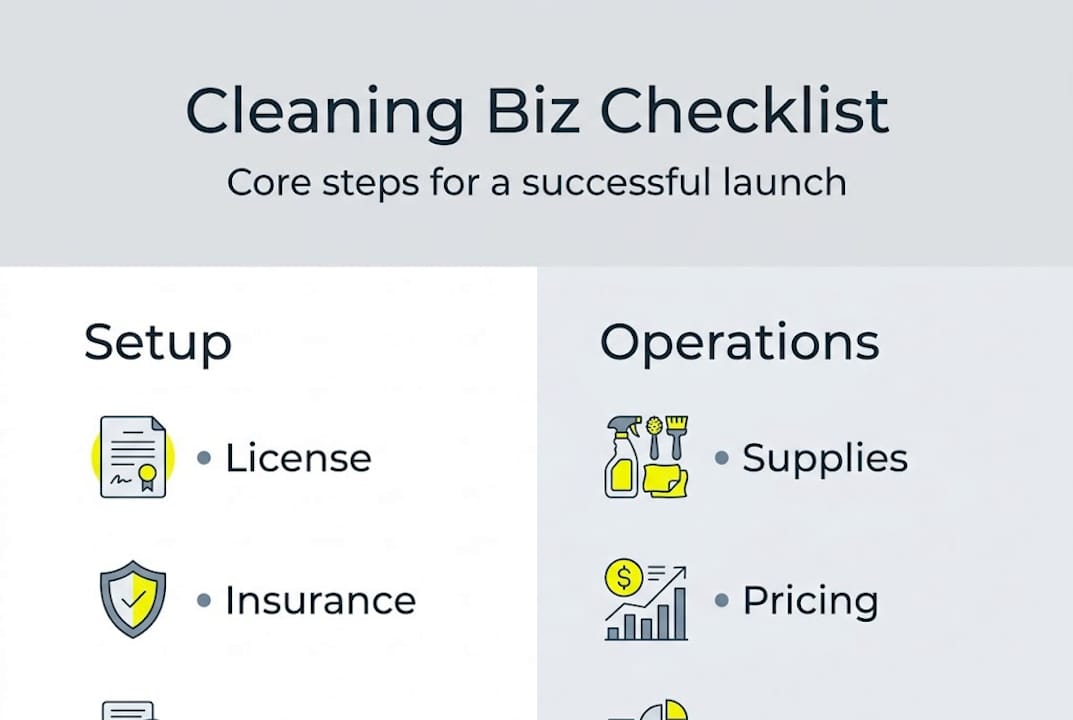
Getting the right cleaning supplies and tools
You cannot show up to a job unprepared. Having the right supplies from day one protects your reputation and your efficiency.
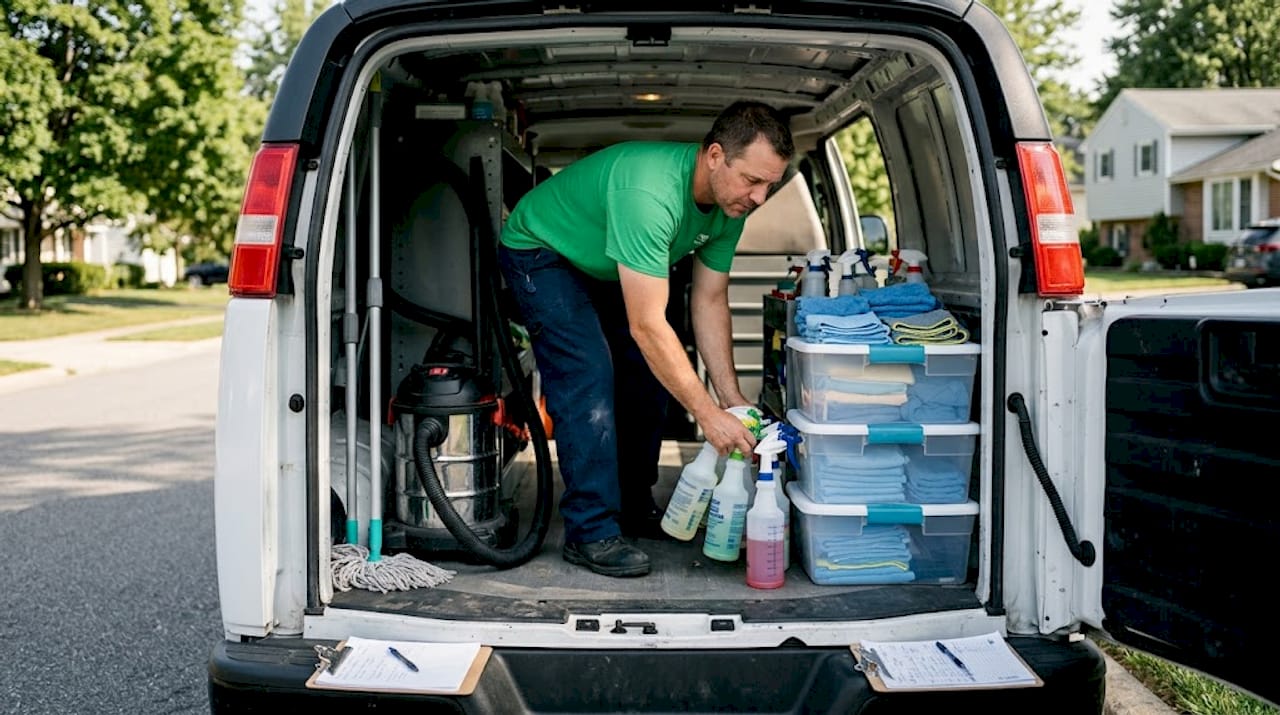
Startup supply costs typically range from $150 to $600 for a basic starter kit, depending on whether you focus on residential or commercial work.
Here is a practical starter list by service type:
Residential and Airbnb turnover cleans:
Microfiber cloths (at least 24)
Multi-surface spray cleaner
Disinfectant and bathroom cleaner
Mop and bucket with wringer
Vacuum with attachments
Glass cleaner
Toilet brushes (color-coded by client home)
Caddy or tote for transport
Commercial and office cleans:
Commercial-grade mop and flat mop heads
HEPA vacuum
Floor cleaner appropriate for tile and hardwood
Trash liners in multiple sizes
Disinfecting wipes for high-touch surfaces
In St. Augustine and Nocatee, humidity is a real concern. Stock a mold-and-mildew spray and use it routinely in bathrooms and laundry rooms. Clients with vacation rentals will notice if you overlook this.
Pro Tip: Buy in bulk from a janitorial supply company rather than a grocery store. You will save 30 to 50 percent on items you use daily. If you handle high-traffic rental properties, industrial-grade products will protect surfaces better and extend your cleaning time between visits.
Store all chemicals in a locked container in your vehicle and keep a product safety sheet for each one. This is a best practice and, in some counties, a legal requirement.
Local marketing and operational tips for success
Having the right supplies and legal setup gets you started. Growing your business in this region takes a different kind of work.
Here is a step-by-step approach to local marketing:
Claim your Google Business Profile. Add photos, your service area (St. Augustine, Ponte Vedra, Nocatee), and your contact details.
Join local Facebook groups for homeowners and Nextdoor neighborhoods. These are active in this area and drive strong referral traffic.
Partner with local real estate agents and property managers. They need reliable cleaners for listings, move-outs, and vacation turnovers.
Ask for reviews after every job. A five-star review from a Nocatee homeowner reaches hundreds of their neighbors.
Offer a referral discount. A $20 credit for every new client referred keeps your existing clients engaged.
For operational efficiency, the wall method is a proven field technique. You move around each room in a fixed order, always following the same wall. This prevents skipping surfaces and cuts cleaning time significantly.
Also, group your jobs geographically. Driving across town between clients burns fuel and time. Schedule St. Augustine clients on one day and Ponte Vedra clients on another.
Property manager tip: For rental turnovers, mold prevention and fast turnaround are the two things that matter most. Build a specific turnover checklist and stick to it for every unit.
For office clients, your office cleaning checklist should cover high-touch surfaces, restrooms, break rooms, and entryways as standard items on every visit.
Our take: What most checklists leave out about local cleaning business success
Most startup checklists focus on licenses and supplies. Those matter. But the businesses we see thrive in this area do something else: they invest in small process habits that build deep client trust.
Sending a check-in text when you arrive and a post-clean photo when you leave takes 90 seconds. It tells the client their home is in good hands without them needing to ask. Property managers especially appreciate this because they often are not on-site.
Networking with HOA groups and property management companies in Nocatee and Ponte Vedra is another underused strategy. These connections do not just bring one client. They bring entire communities.
We also recommend building a move-in clean checklist specific to this region. Move-in cleans in Florida require extra attention to mold, ceiling fans, and AC vents due to the climate. A checklist built for local conditions shows clients you understand their actual needs, not just generic cleaning tasks.
Flexibility matters too. A rigid service menu loses clients who need something in between a standard clean and a full deep clean. Build your checklist with optional add-ons so clients feel heard.
Partner with local experts for hassle-free cleaning success
Putting a checklist into action is easier when you have a trusted local team behind you. My Lemon Maids provides professional residential and commercial cleaning across St. Augustine, Ponte Vedra, and Nocatee, with services built around what this community actually needs.
Whether you need deep cleaning services for a property between tenants or reliable commercial cleaning in St. Augustine for your office, our team brings local knowledge and a consistent process to every job. We handle deep cleaning, standard cleaning, Airbnb turnovers, post-construction cleanup, window cleaning, and pressure washing. Book a consultation or get an instant quote today to see how we can support your cleaning goals.
Frequently asked questions
What business licenses are required to start a cleaning company in Florida?
You will need to register your business structure and verify local licensing through the Florida DBPR, plus check any county zoning or permit rules that apply to your area.
How much should I budget for cleaning business startup costs?
Plan on spending $150 to $600 on supplies and $50 to $300 on licenses during your first year, depending on your business structure and county requirements.
How do I set competitive prices for house cleaning services?
Compare hourly, flat rate, and square footage pricing methods, then calculate your actual costs before setting any client rates.
What is the ‘wall method’ for cleaning?
The wall method means moving around each room in a consistent order along the walls, which improves speed and ensures no surface is missed.
Do property managers need a different cleaning checklist?
Yes. Property managers should prioritize turnover cleans and mold prevention for rentals, especially given the high humidity levels common throughout the St. Augustine region.
Recommended
Comments