How to deep clean your dental office for compliance
- Glenn Brosnick
- Apr 12
- 7 min read
TL;DR:
Deep cleaning targets hard-to-reach zones and porous surfaces beyond routine wipe-downs.
Proper staff training, correct disinfectant use, and thorough documentation are essential for compliance.
Specialized healthcare cleaning services ensure safety and regulatory adherence for dental practices.
Running a dental practice in St. Augustine, Ponte Vedra, or Nocatee means holding yourself to a higher standard than the average office. A single failed inspection or patient complaint about cleanliness can cost you far more than a cleaning bill. The ADA emphasizes proper staff training, EPA and FDA disinfectant use, and compliance documentation as non-negotiable elements of infection control. This guide walks you through exactly what deep cleaning looks like in a dental setting, from assessing your risk areas to verifying results and keeping records that protect your practice.
Table of Contents
Key Takeaways
Point | Details |
Compliance relies on documentation | Maintain records and follow CDC/ADA protocols to pass inspections and protect patients. |
Specialized cleaning is a must | Dental offices require healthcare-grade cleaning, not just routine janitorial services. |
Use proper PPE and disinfectants | Select EPA-approved products and train staff in correct safety procedures for maximum efficacy. |
Verify and improve processes regularly | Ongoing checks and documentation prevent common cleaning mistakes and safety lapses. |
Assessing your dental office’s deep cleaning needs
Understanding the hazards helps you appreciate why a deeper approach is necessary. Most dental offices rely on daily surface wipe-downs between patients, but that routine is not deep cleaning. Surface cleaning removes visible debris. Deep cleaning targets pathogens in hard-to-reach zones, porous surfaces, and equipment that standard protocols miss entirely.
Cleaning reduces infection risk and keeps your practice aligned with CDC guidelines. That means going beyond what looks clean to what actually is clean at a microbial level.
Here are the highest-risk areas in most dental offices:
Dental chairs and armrests where patient contact is constant
Bracket tables and instrument trays that collect aerosol and splatter
Light handles and switches touched repeatedly with gloved hands
Suction lines and cuspidors that harbor moisture and biofilm
Countertops and drawer pulls in operatories and sterilization rooms
Waiting room chairs, door handles, and check-in surfaces touched by patients before treatment
Restrooms shared by staff and patients
Use this table to evaluate where your current routine may fall short:
Area | Routine cleaning frequency | Deep cleaning frequency needed |
Operatory surfaces | Daily | Weekly or after each patient series |
Sterilization room | Daily | Weekly |
Waiting room | Daily | Monthly |
Break room | Weekly | Monthly |
Restrooms | Daily | Weekly |
Air vents and ceiling tiles | Rarely | Quarterly |
Review your current cleaning log against this table. If any zone has gone longer than the recommended interval, that is a clear signal you need a professional deep clean. You can also find practical office cleaning tips and guidance specific to cleaning for dentists to help you build a stronger baseline.
Pro Tip: Walk your operatories with a UV flashlight after your next routine cleaning. You will likely find missed splatter zones around light handles and bracket tables that your team does not catch during standard wipe-downs.
Tools, materials, and safety requirements for deep cleaning
Before tackling the job, ensure your team has all the necessary tools and understands the regulations. Showing up with the wrong disinfectant or missing PPE is not just inefficient. It can create liability.
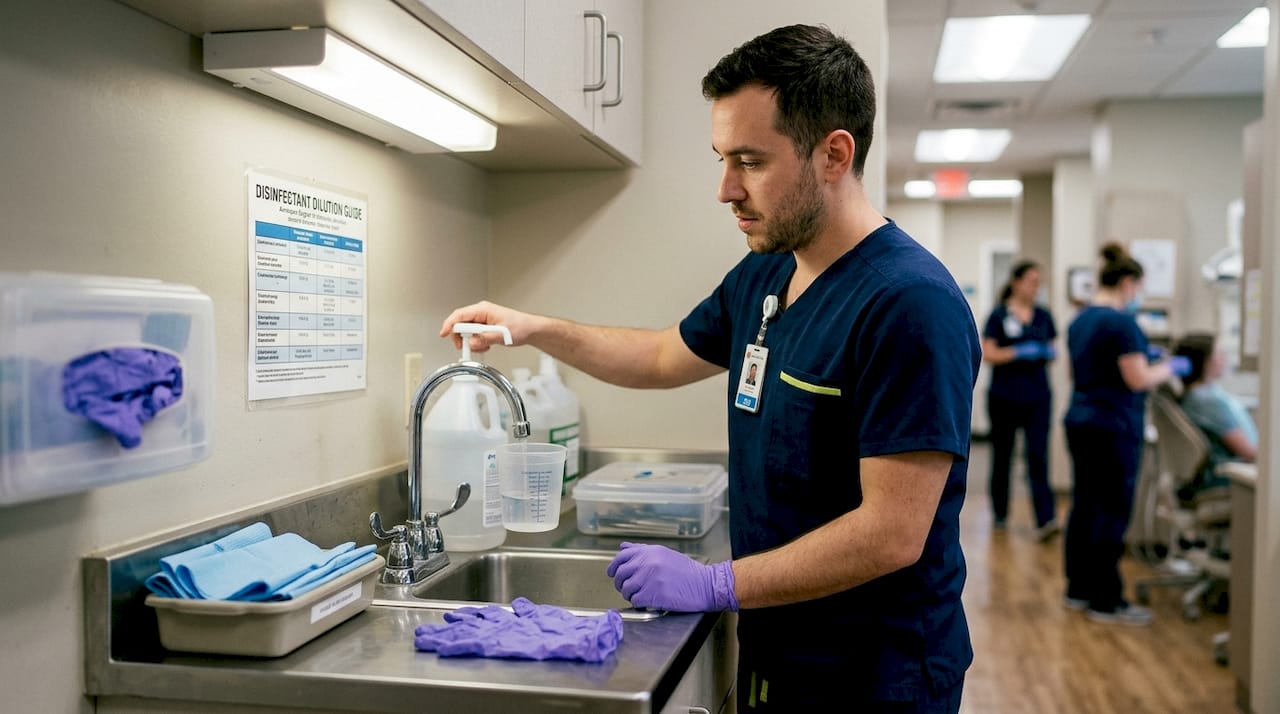
Staff should be trained on proper dilution and safe use of disinfectants as specified by the manufacturer and EPA. This is not optional. It is a documented requirement.
Here is a comparison of disinfectant types commonly used in dental settings:
Disinfectant type | Best use | Contact time | EPA registered |
Quaternary ammonium | General surfaces, waiting areas | 10 minutes | Yes |
Sodium hypochlorite (bleach) | High-risk zones, spill cleanup | 1 to 10 minutes | Yes |
Hydrogen peroxide | Operatory surfaces, equipment | 1 to 5 minutes | Yes |
Phenolics | Hard non-porous surfaces | 10 minutes | Yes |
For full ADA sterilization guidance, review the regulatory requirements before selecting your products.
Your PPE checklist for deep cleaning staff should include:
Nitrile gloves (heavy-duty, not examination weight)
Eye protection or face shield
Fluid-resistant gown or apron
Closed-toe shoes
N95 or surgical mask when working in aerosol-heavy zones
Documentation matters just as much as the cleaning itself. Keep a log of which products were used, at what dilution, by whom, and on which date. Review medical office cleaning compliance practices to make sure your records meet current standards.
Pro Tip: Store your disinfectant dilution chart laminated and posted in the sterilization room. It removes guesswork and gives inspectors visible proof that your team follows protocol.
Step-by-step deep cleaning process for dental offices
With everything assembled, you are ready to follow proven procedures for deep cleaning. The most important rule is to move from low-contamination areas to high-contamination areas. This minimizes the risk of spreading pathogens from operatories into waiting areas or break rooms.
Follow this order of operations:
Waiting room and reception: Wipe all chairs, armrests, and hard surfaces. Clean door handles, light switches, and the check-in counter. Vacuum upholstered seating and mop hard floors.
Break room and staff areas: Clean countertops, appliances, cabinet pulls, and sinks. Sanitize shared surfaces like coffee makers and refrigerator handles.
Restrooms: Scrub toilets, sinks, and floors. Disinfect all touchpoints including faucets, soap dispensers, and door handles.
Sterilization room: Clean all countertops, instrument storage areas, and autoclave exteriors. Wipe down sinks and any equipment surfaces.
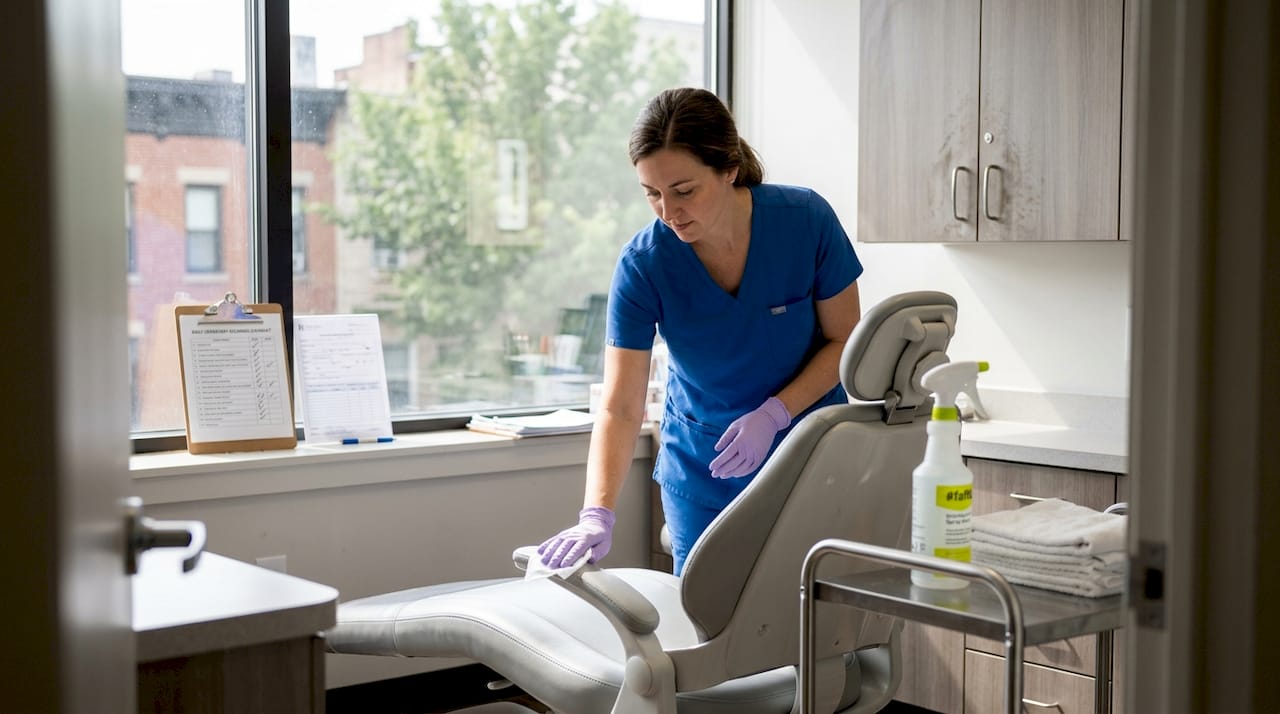
Operatories: Start with floors, then move to walls and cabinetry. Clean and disinfect dental chairs, armrests, headrests, bracket tables, light handles, and suction equipment. Apply disinfectant at the correct dilution and allow full contact time before wiping.
Final documentation: Record every area cleaned, the products used, contact times observed, and the staff member responsible.
“Competency should be assessed and procedures included in the Hazard Communications manual.” This means your cleaning protocol is not just a checklist. It is a compliance-documented workflow that must be reviewed and updated regularly.
Studies show that dental operatory surfaces can harbor pathogens for hours after patient contact without proper disinfection. Contact time is critical. Do not wipe a surface before the disinfectant has had time to work.
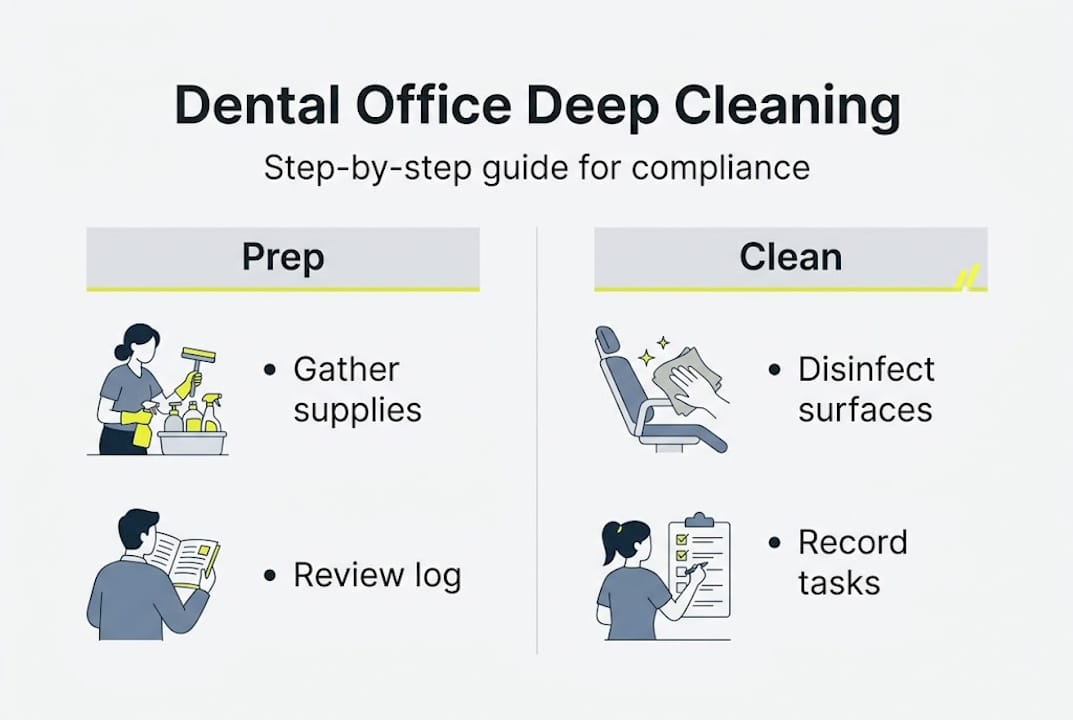
For a structured approach, review a dental cleaning workflow or follow a step-by-step office cleaning guide to keep your team consistent.
Validation, documentation, and common mistakes to avoid
You have implemented the steps, but confirmation and documentation are essential to close the process. Cleaning without verification is like treating a patient without charting. You have no proof it happened correctly.
ADA and CDC recommend verifying procedures and maintaining relevant documentation as part of your infection control program. Here is how to do that practically.
Verification methods:
Visual inspection of all surfaces for residue, streaks, or missed zones
ATP bioluminescence testing on high-touch surfaces to measure organic contamination
Swab testing in sterilization rooms or operatories after cleaning
Periodic third-party audits by a qualified cleaning provider
What to document after every deep clean:
Record type | What to include | How often |
Cleaning log | Date, area, product, dilution, staff name | Every session |
PPE compliance | Who wore what and when | Every session |
Verification results | ATP readings or visual check outcomes | Monthly |
Training records | Who was trained, on what, and when | Annually or on hire |
Common mistakes that put practices at risk:
Improper dilution: Too weak means ineffective. Too strong can damage surfaces and create chemical exposure risk.
Missed surfaces: Light handles, chair adjustment buttons, and suction valves are frequently skipped.
Incomplete training: Staff who do not know contact times or product requirements are a liability.
No documentation: Without records, you cannot prove compliance during an inspection.
Pro Tip: Schedule a quarterly internal audit where you review cleaning logs, test two or three surfaces with ATP strips, and update your Hazard Communications manual. This keeps your team sharp and your records inspection-ready.
For a closer look at what inspectors expect, review medical cleaning standards that apply to healthcare environments like yours.
Our take: Why specialized dental office deep cleaning is worth the investment
Having learned the critical steps, let us consider why expertise and specialization truly matter for your practice and your patients.
Many general cleaning companies in the St. Augustine and Ponte Vedra area do a fine job in standard offices. But dental practices are not standard offices. They carry aerosol contamination, bloodborne pathogen risk, and regulatory oversight that most janitorial crews are simply not trained to handle.
Specialized cleaners knowledgeable in CDC/OSHA guidelines are recommended over generalists for exactly this reason. We have seen practices that passed visual inspections but failed ATP testing because their cleaning crew did not know contact times or proper dilution ratios.
The risk is real. A non-specialist crew may clean what looks dirty and ignore what does not. In a dental setting, that is where the actual danger lives. Choosing a provider who understands why specialized cleaners matter is not a luxury. It is a patient safety decision.
Screen your provider. Ask about their healthcare cleaning protocols, their staff training records, and whether they carry liability coverage for medical environments. If they cannot answer those questions clearly, they are not the right fit for your practice.
Professional deep cleaning services for St. Augustine dental offices
If you manage a dental office in St. Augustine, Ponte Vedra, or Nocatee and want to make sure your facility meets healthcare-grade standards, local expert help is available.
At Lemon Maids, we provide deep cleaning services built around the specific needs of commercial and healthcare environments. Our office cleaning for dental practices includes proper disinfectant protocols, staff trained in compliance requirements, and thorough documentation so you are always inspection-ready. We also offer full commercial cleaning solutions for practices that need ongoing support. Get in touch today to schedule a consultation or request a quote tailored to your practice size and cleaning frequency.
Frequently asked questions
How often should a dental office be deep cleaned?
Dental offices should conduct deep cleaning at least quarterly, though CDC and ADA recommend adjusting frequency based on patient volume, infection control risk, and any outbreak events.
What is the difference between regular and deep cleaning in a dental office?
Regular cleaning removes surface dirt and debris, while deep cleaning uses advanced disinfectants and compliance-grade protocols to target hidden pathogens in high-risk zones.
Who can perform deep cleaning for dental offices in St. Augustine?
Look for commercial cleaners who specialize in healthcare environments and are familiar with CDC and OSHA standards, rather than general janitorial services.
What mistakes should be avoided during dental office deep cleaning?
The most common errors include improper disinfectant dilution, skipped touchpoints, and missing documentation, all of which the ADA advises against in its infection control guidelines.
Recommended
Comments